Showing posts with label Interesting Papers. Show all posts

Friday, December 22, 2017

The High Cost of Good Intentions

The High Cost of Good Intentions is a superb new book by my Hoover colleague John Cogan. It is a political and budgetary history of U.S. Federal entitlement programs. It is full of lessons for just why the programs have expanded inexorably over time, and just how hard it will be for our political system to reform them.

If indeed the Congress will now turn to entitlement reform, as house speaker Paul Ryan has promised, this will be the book to have on your desk. (Ryan already blurbed it (back cover) as did Bill Bradley, Sam Nunn, George Shultz and Alan Greenspan.)

If you think entitlement programs, and the political hash that enacts them, are recent problems, or the fault of one political party, think again. John's main lesson is that the emergence of bloated entitlements is a hardy feature of our (and many other countries') democracies.  He does this by just reading the history.

The habit of expanding entitlements started early. Chapter 2:
Revolutionary War pensions were the nation's first entitlement program. ... between 1789 and 1793, the federal government agreed to pay annual pensions to Continental Army soldiers and seamen who became disabled as a result of wartime injuries or illness. [later, as an inducement to service]... 
For forty years, Congress enlarged and expnaded these benefits until, by the 1830s, they covered virtually all Revolutionary War seamen and soldiers, including volunteers and members of the state militia and their widows, regardless of disability or income. 
That costs might balloon beyond forecasts was not a total surprise


Opponents of the 1818 law predicted that granting lifetime pensions to Revolutionary War veterans who were "in reduced circumstances" would be costly. Senator Nathaniel Macon of North Carolina observed, "Pensions in all countries begin on a small scale and are at first generally granted on proper consideration, an that they increase till at last they are granted as often on whim or caprice...[it] will on experiment, be found an endless task. It will drain any treasury, no matter how full." 
Yet, the service pension law of 1818, which granted such pensions to all revolutionary war veterans who were "in reduced circumstances"
produced a massive surge in applications and an unexpected and unprecedented cost to the Treasury. The law's proponents had estimated that fewer than two thousand veterans would qualify and that the annual cost might reach $115,000. But by the end of 1819, more than twenty-eight thousand individuals had applied... The 1818 law's annual cost to the Treasury had ballooned from $300,000 to a staggering $1.8 million. ..widespread charges of pension fraud and corruption. A law designed to assist destitute veterans was providing pensions to many financially well-off veterans and even many who had never fought for the nation's independence. 
...Congress's underestimate of the cost was on the first of many underestimates. These miscalculations are invariably due to Congress's failure to appreciate how an offer of entitlement assistance can cause individuals to change their circumstances to qualify for aid they have previously managed to live without. 
This is a familiar theme in entitlement programs, but just how far back it goes was news to me.

A bigger theme of the book is the politics of entitlements. That also starts long ago. Congressman Dudley Marvin of New York reports
"In the villages in his part of the country, when the semi-annual pay day arrived, they [pensioners] were in the habit of forming themselves into companies, then forming a column and thus marching to receive their quota of the public bounty" 
This spectacle served as an early hint of the sense of entitlement that can affect groups of recipients of public assistance... such groups can develop an expectation that society owes them benefits that initially were bestowed out of gratitude for military service or a desire to alleviate hardship. We will observe this expectation and the sometimes remarkable behavior it generates in later chapters on twentieth-century entitlements. 
For example, a century later, the linkage between individual payroll taxes and benefits was crucial to the "enactment, long-run endurance, and, ultimately high cost" of Social Secrurity
Paying payroll taxes gave [gives!] program participants a sense that by contributing to the program during their working years, they were establishing an earned right to benefits when they retired. ... Senate Finance Committee chairman Walter George noted" Social security is not a handout; it is not a charity; it is not relief. It is an earned right based upon the contributions and earnings of the individual.  
When [President Roosevelt] was challenged about financing Social Security with a regressive payroll tax rather than general fund revenues from the progressive income tax, he replied, "We put those pay roll contributions there so as to give the contributors a legal, moral, and political right to collect their pensions and their unemployment benefits. With those taxes in there, no damn politician can ever scrap my social security program. Those taxes aren't a matter of economics, they're straight politics" 
Civil war pensions followed the same path, on a larger scale
The civil war pension program began with the same high-mihnded, noble, and limited goal as Revolutionary War pensons: to compensate soldiers for the loss of life and limb suffered in wartime service to their country... A half-century later the program evolved into a general disability and retirement program for virtually all Union soldiers...Congress also eventually stretched eligibility for pensions to virtually all widows and survivors of union soldiers, even those who had married many decades after the war had ended..
Costs ballooned, for example on the 1879 arrears law, that allowed soldiers to file disability claims after the original deadlines
The bill's senate floor manager, Sentaor John Ingalls, had put the total at $18 to $20 million. Hayes administration officials estimated a much higher cost of between $50 and $150 million. ... Two years after the law's passage President Chester A. Arthur reported that arrears payments had already cost taxpayers $235 million...It is fair to conclude that the law added nearly $400 million to pension expenditures during the 1880s alone  
New interest and lobbying groups emerged
claims agents led the advocates for arrears payments. These agents, certified by the pensions office, assisted veterans and widows with the complex application process, represented claimants in appeals before the pension office, and received compensation for their services. ... claims' agents had emerged as a powerful lobbying force. 
... The arrears act also spawned a second large national lobbying force: The Grand Army of the Republic (GAR). The GAR's evolution from a service organization ta special interest lobby..would be followed time and again by twentieth-centry lobby groups...
At this time, politicians discovered how important entitlements could be to electoral success, beginning the mad use of public money to buy votes that we see today.
The (1884) election campaign witnessed the use of the Pension office as a political machine to gain partisan advantage. (good story follows) 
... Along with this legislation came an important and powerful discovery by the Congress and the executive branch: broadly distributing cash benefits directly to a large segment of the voting population could produce significant electoral advantages. 
The story repeats again with WWI veterans.

There are occasional retrenchments and reforms, especially useful to ponder now.
Candidate Cleveland renewed his previous campaign promise to `cleanse the pension rolls and limit ... benefits to 'worthy' veterans. ...Voter backlash against the tariff and pension corruption contributed to President Cleveland's landslide victory.... Cleveland took immediate actions... The GAR rallied against this minor reform as if the pension rolls had been purged, decrying "false economy which shaves and pares to the quick at the expense of honor, justice and principle." ... by the time Preisdent Cleveland left office in 18997, there were 12,500 more Civil war pensioners than when he had taken office. 
Interestingly, Franklin Roosevelt was a great enemy of large veteran benefits. Roosevelt
shared the founding fathers' belief that all citizens had an obligation to serve their country in wartime, and therefore did not represent a special class of individuals entitled to government benefits merely because they had served during wartime. .. His views were decidedly at odds with Congress, which invariably concluded that all wartime veterans, especially when they reached old age, stood as a special class. 
 Roosevelt also thought balanced budgets were important. He acted cleverly:
On Sunday night, the President gave the first of his legendary fireside chats, reassuring the public that the US banking system was in should shape. On Monday he sent to Congress his third message: to modify the Volstead Act to permit the sale of beer... an extremely popular proposal. Now the Senate was in a bind. Under Senate rules, action on the Volstead act could not take place until the Economy act had been addressed... 
and they passed it
The law repealed all entitlements to pensions that had been granted to veterans of World War I, the Spanish American War, the Boxer Rebellion and the Philippine insurrection.. For the first [last?] time in US history, a large-scale entitlement had been repealed. ... 
Several factors account for President Roosevelt's remarkable success in reducing veteran's pensions. The economy and federal budget's dire situation presented the president with a national emergency, and in Washington such emergencies are a strong predicate for action.. President Roosevelt was also willing to use his veto power to sustain his policies... 
Roosevelt's attitude to veterans did not last.

*****

I'm up to the beginning, really, of the book, "The birth of the modern entitlement state." The centerpiece of the book is not these historical antecedents, but the political story of how the current US entitlements system evolved.

That story starts with the New Deal. It also brings in the judiciary, the "role of the federal courts in making public policy:"
The new Deal entitlements ushered in a new era for the federal courts. ... once federal entitlement rights had been granted, the nature and extent of these legal right had to be adjudicated....In the 1960s and 1970s, the federal courts .. expanded[ed] the legal rights of entitlement claimants in welfare, health care, and nutrition. Ultimately federal court decisions created welfare entitlement right where none had been legislated. 
There are many more themes worth stressing, even in the ancient history, and I won't prolong the quotes delicious as they are.

One theme: Our government routinely liberalizes entitlements when budget surpluses are strong, and at least slows down their expansion in bad fiscal times. It also liberalizes entitlements in bad economic times.

That bears centrally on the current reform question.  Our entitlements are, no surprise, on an unsustainable path. We will either reform them, in a way that reduces federal spending, or we will substantially raise taxes on the "middle class," including a large payroll tax increase and likely a european style VAT on top of growth-killing income and corporate taxes.

If one wishes for a reform on the expenditure side, the great question is whether it must be done directly or via "starving the beast" of tax revenue. For example, I advocate a VAT. A common complaint is that the VAT is not only a much more economically efficient way of raising a given revenue, it is a great way to raise much more revenue, and my critics complain it soon will do that and provoke even greater spending. The VAT shifts the top of the Laffer curve to the right, and in my critics' view, the US government will operate at the top of the long-run Laffer curve given structural limitations on its tax code.

I have held out hope that our democracy could contain itself to spend less than the top of the Laffer curve allows, so we can jettison the insane inefficiency and corruption of our tax code, and have one that is vastly more economically efficient. The opposite view really amounts to belief that democracy is fatally flawed. Moreover, I note that starve the beast tax reductions have led to massive deficit expansions, yet large debt and deficits have not yet seemed to provide much pressure against entitlement spending.

John's history is a strong push toward starve the beast, at least in the negative direction. Surpluses lead to benefit expansions, quickly.

Another theme: The accounting gimmicks such as "trust funds." Surpluses in trust funds lead to benefit expansions, even if there are huge deficits outside. And "trust fund" accounting gimmicks also go back a long way.

As we (hopefully) start to think about reform, I think the only hope is to break out of "we're spending too much there will be a debt crisis" vs. "you heartless evil person, just look at (deserving person). How can you throw her off the bus." The way to do that, I think, is to focus on the disincentives of our social programs, not on the cost or the worthiness of recipients. I find some comfort in John's history, that occasional retrenchments, including the above and the welfare reforms of the 1990s got through politically by looking at fraud (a form of disincentive) and other disincentives.

This is a history and a political history, not a reform proposal, nor an economic analysis of disincentives. Still, John's history is also full of quotes reflecting the centuries old tension in welfare programs between helping those in need and disincentives, which I'll cover in the next post. That history ought to help.

A note for graduate students: This book is very well written, and you should read it to emulate writing style as well as for the subject. No, it does not knock you over the head with beautiful sentences as John McPhee might. It is, however, beautifully structured. The whole book and each chapter starts with a complete summary of the argument, and the chapter fills it out. It could go on for thousands of pages, but manages to tell just enough of the story so you see the historical detail, but not enough so you get lost in what must been have fascinating historical detail. Yet this is not a standard quickie book aimed at a policy controversy. This is a deep piece of scholarship. Everything is footnoted -- 78 pages of footnotes and reference all together.


Read more

Monday, October 24, 2016

A Behavioral new-Keynesian Model

Here are comments on Xavier Gabaix' "A Behavioral new-Keynesian model." Xavier presented at the October 21 NBER Economic Fluctuations and growth meeting, and I was the discussant. Slides here

Short summary: It's a really important paper. I think it's too important to be true.

Gabaix' irrationality fixes the pathologies of the standard model by making a stable model unstable, and hence locally determinate. Gabaix' irrationality parameter M in [0,1] can thus substitute for the usual Taylor principle that interest rates move more than one for one with inflation.


Gabaix imagines -- after three papers worth of careful math -- that people pay less attention to future income when deciding on consumption than they should.  Making today's consumption less sensitive to future income, means expectations of future income are larger for any amount of today's consumption. Thus, it makes model dynamics unstable.

But just a little irrationality won't do. If you move a stable eigenvalue, say 0.8, by a bit, say 0.85, it's still stable. You have to move it all the way past 1 before it does any good at all.

Thus, Gabaix puts irrationality right in the  middle of monetary policy. If Gabaix is right, you simply cannot explain monetary policy in simple terms with money supply and money demand, or interest rate rises lower investment and inflation via a Phillips curve, as simple approximations that more complex models, perhaps involving some irrationality, improve on. Monetary policy is centrally about the Fed exploiting irrationality, full stop, and cannot be explained or understood at all without that feature.

More in the comments. There are too many equations and figures to mirror it here, so you have to get the pdf if you're interested. This is for academics anyway.
Read more

Wednesday, October 9, 2013

Mulligan on Obamacare Marginal Tax Rates

Casey Mulligan wrote a nice Wall Street Journal Oped last week, summarizing his recent NBER Working Paper (also here on Casey's webpage) on marginal tax rates.

What do I mean, tax, you might ask. Obamacare is about giving people stuff, not taxing. Sadly, no. Obamacare gives subsidies that are dependent on income. As you earn more, you receive fewer subsidies for health care, reducing the incentive to earn more. Casey tots this sort of thing up, along with the actual taxes people will pay.

Economists use the word "tax" here and we know what we mean, but it would be better to call it "disincentives" so it's clearer what the problem is, and just how painful we make it for poor people in this country to rise out of that poverty.

As you can see, the average marginal "tax" rate went up 10 percentage points since 2007, and about 5 percentage points due to Obamacare alone.

Going back to the working paper, I think this is actually an understatement. (Probably the first time Casey or I have ever been accused of that!)


First, not even Casey can add everything up, and it all adds in one direction. State and local taxes, and vast number of state, county, city and other income or asset-based transfers all add. I haven't read all his papers or the whole book yet, but did Casey get them all? For example, I just got in the mail notice for a little program offered by the state of Illinois to lower your property taxes if you earn less than $100,000 per year. Nice, but one more little incentive not to earn more than $100,000 per year, and not in Casey's calculation.

In email correspondence, Casey pulled me back from these thoughts in a way that is revealing about the calculation. I wanted to add sales tax. After all, if you earn a dollar, but you have to pay 10% sales tax to do anything with it, that's another 10% distortion, no? Casey responds no, because he wants to measure the income-compensated distortion to labor, period. If you don't work, and somehow you also get income, you still have to pay the 10% sales tax. So the sales tax does not distort that pure work-no work decision. Casey's right, but I think this clearly illuminates the conservative nature of his calculation and what it means. There are a lot more margins, wedges, and distortions out there, and he's not trying to measure them all. He's also not trying to measure the wedges and disincentives for employers to hire people, towards non-market activities, and certainly not the effects of the regulatory tangle.

Another note of conservatisim: "The results account for the fact that many people will not participate in programs for which they are eligible." This is an important issue, that at least had not sunk in for me until reading a recent CBO report. People don't sign up for all the benefits to which they are eligible. If they did, marginal tax rates would be astronomical. It also sends a warning: Just how long will it be before people in an increasingly stagnant economy figure out all the programs they are eligible for?

Drawing a single line can also be unduly calming. You might say, "well 50% isn't so bad. Europeans still work, sort of, paying 50% marginal tax rates."  But as Casey reminds us, the spread in marginal tax rates across people is enormous. For example, the paper has a nice example (p. 13, table 2) of how a typical earner will come out ahead by choosing to work part time and receive subsidies, rather than work full time. This is a case of a 100% marginal tax rate.

It's likely that the effect of marginal taxes is nonlinear. Much of the labor decision comes in chunks: work or don't work; work part time or full time; apply for benefits or don't, with transactions costs and irreversibilities.  Suppose half the population feels a 100% marginal tax rate and half feels zero. Half the population works, half does not. That is likely a much larger effect than if the whole population felt a 50% marginal tax rate.

In sum, it's probably worse than even Casey's graph. But Casey is doing the right thing in putting up a carefully documented graph and paper rather than speculating. Speculation is for blogs, not papers and not for good opeds.

And Casey's big point remains the additional effect of Obamacare and other changes to Federal programs. Whatever you think the level is, it's now 10 percentage points more than what it used to be. On average.

Read more

Friday, July 19, 2013

Health Insurance and Labor Supply

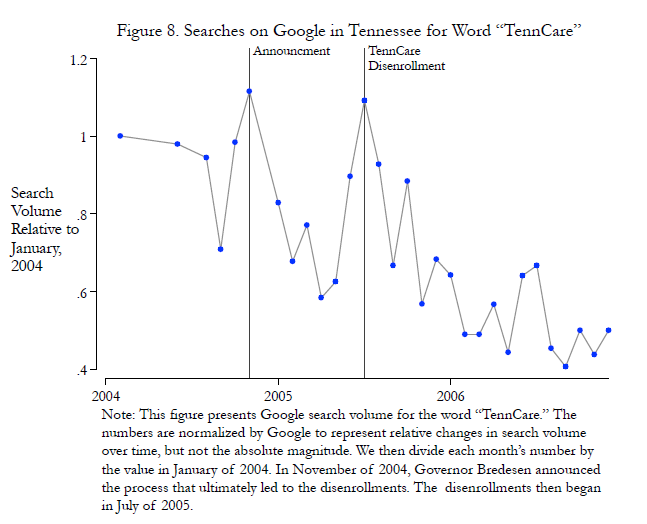
I just ran across an interesting paper, "Public Health Insurance, Labor Supply, and Employment Lock" by  Craig Garthwaite,  Tal Gross and my Booth colleague Matthew Notowidigdo.

They study an interesting event
... In 2005, Tennessee discontinued its expansion of TennCare, the state’s Medicaid system. ... Approximately 170,000 adults (roughly 4 percent of the state’s non-elderly, adult population) abruptly lost public health insurance coverage over a three-month period.
The result was
a large and immediate labor supply increase....we find an immediate increase in job search behavior and a steady rise in both employment and health insurance coverage. 

They call the phenomenon "employment lock." This is different from "job lock," people with preexisting conditions who stay with jobs they didn't want in order to keep health insurance. "Employment lock" is the choice by healthy people to work at all in order to get  insurance, or put in academic prose, "strong work disincentives from public health insurance that are unrelated to strict income-based eligibility limits."

The converse is a new danger for the ACA
Additionally, our estimates may provide useful guidance regarding the likely labor supply impacts of the ACA...

If such individuals could instead acquire affordable health insurance apart from their employer, many of them would exit the labor force entirely. As a result of employment lock, policies that expand access to health insurance apart from employers (such as the ACA) may have large labor market effects

... Using CPS data, we estimate that between 840,000 and 1.5 million childless adults in the US currently earn less than 200 percent of the poverty line, have employer-provided insurance, and are not eligible for public health insurance.Applying our labor supply estimates directly to this population, we predict a decline in employment of between 530,000 and 940,000 in response to this group of individuals being made newly eligible for free or heavily subsidized health insurance. 
They are quick to point out that this is not necessarily a bad thing."the effects do not necessarily imply a welfare loss for individuals choosing to leave the labor force after receiving access to non-employer provided health insurance." If people only work at a job they hate in order to get health insurance, then people may be better off not working. The policy world often just assumes more employment is always a great thing, which isn't true.

However, less employment is not necessarily a good thing either. These are childless adults. How are they supporting themselves if they don't work? Can it possibly be optimal for them to just sit around the house? We surely don't want to compare employer-provided health insurance with highly subsidized individual insurance for the unemployed-- that's a subsidy to leisure and obviously skewing the scales.

Most of all, low-income single people face extraordinarily high marginal tax rates and other disincentives to work. So, an artificial incentive to work in order to get health insurance may offset some of the otherwise irresistible incentives not to work. (A good calculation for Casey Mulligan!)

And whether the people are in the end better off working or staying home and receiving larger subsidies, the government and taxpayers are clearly worse off, as the people and their employers are not paying taxes any more.

In sum, academic caution aside, inducing a million childless adults to leave legal employment doesn't look like a good thing to me.  

The evidence is pretty cool. Here are some pictures lifted from the paper.


Read more

Friday, March 1, 2013

The banker's new clothes -- review

I wrote a review of Anat Admati and Martin Hellwig's nice new book, "The banker's new clothes" for the March 2 2103 Wall Street Journal.

Bottom line: Banks should issue a lot more equity, a lot less debt, especially short term debt, and a heck of a lot less nonsense.

I admire Anat and Martin. The rest of us read the gobbledygook in the newspapers, chuckle at the faculty lunch -- "Ha ha, xyz is CEO of a huge bank and has never heard of Modigliani-Miller! Ha Ha -- pdq is a senior regulator, and doesn't know the difference between capital and reserves!" -- and then we go about our business. Anat and Martin have admirably taken the bull by the horns. They write opeds, they go to interminable banking policy conferences, they fight it out with bigwig bankers, regulators, and their consultant economists, and endure their scorn. This nice book summarizes their arguments very clearly (without the foaming at the mouth ranting and raving that I would have had a hard time avoiding in their place!)

(Links: This review at the Wall Street Journal (html), in a pdf from my webpage. Admati and Hellwig have a book website with lots of extra material and response to critics.)

Enough preamble. The review: 

Four and a half years ago, the large commercial banks nearly failed, inaugurating our great recession. They were saved by the Troubled Asset Relief Program, Federal Reserve lending and other government support. If you think all that was bad, imagine the ATMs going dark. What has been done to avoid a repetition of these events? Sadly, and despite all the noise you hear about bank regulation, not much.

The central problem, at the core of Anat Admati and Martin Hellwig's "The Bankers' New Clothes," is capital.

In order to make $100 of loans, a typical bank borrows $97—from depositors, from money-market funds, from other banks, or from bondholders—and sells $3 of stock, its "capital." So if only 4% of the bank's loans fail, the shareholders are wiped out, and the bank cannot pay its debts. Worse, if there is a rumor that some loans are in trouble, creditors may "run," each trying to get his money out first, and force a needless bankruptcy. Think of Jimmy Stewart in "It's a Wonderful Life."

When banks are on the brink, all sorts of other pathologies emerge. Bankers and their regulators may try to keep zombie loans on the books, hoping things will turn around. Or bankers may bet the farm on very risky loans that either save the bank or impose larger losses on creditors and the government. Ms. Admati and Mr. Hellwig explain all this nicely in their first few chapters.

The solution seems pretty obvious, no? Banks should fund their investments by selling a heck of a lot more stock and borrowing a heck of a lot less, especially in the form of run-prone short-term debt, as most other companies do.

Far more value was lost in the 2000 tech bust, for instance, than in the subprime mortgages that sparked the 2008 crisis, but the tech bust did not cause a financial crisis. Why? Tech companies were funded by stocks, not short-term debt. Worried shareholders can drive down the price of a stock, but they have no right to demand that the company redeem shares at yesterday's price, so they can't drive the company to bankruptcy in a run. Depositors and other short-term creditors have a fixed-value, first-come-first-serve promise from a bank—they can run.

More capital and less debt would stabilize the financial system in many ways. If a bank wants to rebuild its ratio of capital to assets from 1% to 2% by selling assets, it has to sell half of its assets. Doing so can spark a fire sale, especially if all the other banks are doing the same thing. If the same bank wants to rebuild capital from 49% to 50% of assets, it only has to sell 2% of its assets. That bank will also have a far easier time issuing more stock, rather than selling assets, which is a better way to build equity in the first place.

The U.S. government has instead addressed the risks of banking crises by guaranteeing bank debt. Guaranteeing debts creates perverse incentives, so our government tries to regulate the banks from taking excessive risks: "OK, cousin Louie, I'll cosign the loan for your Las Vegas trip, but no poker this time, and be in bed by 10."

Ms. Admati and Mr. Hellwig show how this approach has failed, repeatedly, over the course of many years—in the 1984 Continental Illinois rescue; in the Latin American debt crisis and savings-and-loan crisis in the 1980s; in the Asian-currency crisis and the collapse of Long-Term Capital Management in the 1990s; and in the recent financial crisis. Each time, our government bailed out more and more creditors in a wider array of institutions. Each time, our government wrote reams of new rules that banks quickly got around.

Now pretty much all of the big banks' debt is guaranteed, explicitly or implicitly through the widely held expectation that a big bank's creditors will be bailed out. But our regulators promise that next time, trust them, they really will spot trouble ahead and do something to stop it—even though our massive bank-regulation machinery failed to notice that subprime mortgages might be a bit risky in 2006 and even though, as Ms. Admati and Mr. Hellwig note, Europe's regulators still consider Greek government bonds to be risk-free assets.

Most basically, Ms. Admati and Mr. Hellwig point out that current regulation is focused on a bank's assets: the loans, securities and other investments that bring money in (and sometimes don't). They want us to focus instead on the bank's liabilities: the ways banks get money and the promises banks make to depositors and investors. Bank assets are not particularly risky or illiquid. Apple's profits from selling iPhones or a mutual fund's portfolio of stocks are far riskier than any bank's portfolio of loans and mortgage-backed securities, or even their much-disparaged trading books. Bank liabilities—too much debt and too much short-term debt—are the central problem that causes financial crises.

What about those "tough" new capital regulations that you keep reading about? They are not nearly as tough as you think. At best, the new Basel III international bank regulation agreement calls for a 7% ratio of capital to assets by a leisurely 2019 deadline. But that is the ratio of capital to "risk-weighted" assets. Risk-weighting is a complex system in which some assets count less against capital requirements than others. A dollar of mortgage assets might count as 50 cents, but it might count as 10 cents or less if it is a complex mortgage-backed security, and zero if it is government debt. When Ms. Admati and Mr. Hellwig unravel those "risk weights," we're still talking about 2% to 3% actual capital.

Foreseeing the usual risk-weighting games, Basel III requires a backstop 3% ratio of equity to all assets. "If this number looks outrageously low," Ms. Admati and Mr. Hellwig write, "it is because the number is outrageously low." Indeed.

This simple truth has been met by howls of protest and layers of obfuscation and derision by bankers, their consultants and many of their regulators. "Oh, you just don't understand the complexities of banking" is the basic attitude. "Go away and let the experts fix this." Well, Ms. Admati and Mr. Hellwig, top-notch academic financial economists, do understand the complexities of banking, and they helpfully slice through the bankers' self-serving nonsense. Demolishing these fallacies is the central point of "The Bankers' New Clothes."

No, they write, it was not always thus. In the 19th century, banks funded themselves with 40% to 50% capital. Depositors wouldn't lend to banks unless the banks had a lot of skin in the game. Without a government debt guarantee—and, early on, without limited liability—shareholders wanted less risk as well.

"Capital" is not "reserves," and requiring more capital does not reduce funds available for lending. Capital is a source of money, not a use of money. When, as Ms. Admati and Mr. Hellwig gleefully note, the British Bankers' Association complained in 2010 about regulations that would require banks to "hold"—the wrong verb—"an extra $600 billion of capital that might otherwise have been deployed as loans to businesses or households," it made an argument both "nonsensical and false," contradicting basic facts of a bank balance sheet. Requiring more capital does not require banks to raise one cent more money in order to make a loan. For every extra dollar of stock the bank must issue, it need borrow one dollar less.

Capital is not an inherently more expensive source of funds than debt. Banks have to promise stockholders high returns only because bank stock is risky. If banks issued much more stock, the authors patiently explain, banks' stock would be much less risky and their cost of capital lower. "Stocks" with bond-like risk need pay only bond-like returns. Investors who desire higher risk and returns can do their own leveraging—without government guarantees, thank you very much—to buy such stocks.

Nothing inherent in banking requires banks to borrow money rather than issue equity. Banks could also raise capital by retaining earnings and forgoing dividends, just as Microsoft MSFT +0.54% did for years. Every dividend drains capital from banks and removes a layer of protection between us taxpayers and the next bailout. Ms. Admati and Mr. Hellwig are at their best in decrying U.S. regulators' decision to let banks pay dividends in 2007-08—amounting to half the TARP bailouts—and to let big banks begin paying out dividends again in 2011.

Why do banks and protective regulators howl so loudly at these simple suggestions? As Ms. Admati and Mr. Hellwig detail in their chapter "Sweet Subsidies," it's because bank debt is highly subsidized, and leverage increases the value of the subsidies to management and shareholders. To borrow without the government guarantees and expected bailouts, a bank with 3% capital would have to offer very high interest rates—rates that would make equity look cheap. Equity is expensive to banks only because it dilutes the subsidies they get from the government. That's exactly why increasing bank equity would be cheap for taxpayers and the economy, to say nothing of removing the costs of occasional crises.

And, in an all-too-short chapter on "The Politics of Banking," they show us how politicians and regulators like the cozy cronyism of the current system. Banks are, of course, "where the money is," and governments around the world use regulation to direct funds to politically favored businesses, to preferred industries, to homeowners and to the government itself. Politicians want to subsidize and protect their piggy bank. Regulators commonly become sympathetic to the interests of the industry they regulate, which advances their careers in government or back in industry. Last week's news coverage of Treasury Secretary Jack Lew's interesting career is only the most recent reminder.

Part of me wishes that Ms. Admati and Mr. Hellwig had been more specific in their criticisms: naming more names and quoting more nonsense, writing a gripping exposé dripping with their justified outrage. But their restraint is wise: Too much exposé would detract from the clarity of their ideas. So readers will have to recognize the arguments and add their own outrage.

Ms. Admati and Mr. Hellwig do not offer a detailed regulatory plan. They don't even advocate a precise number for bank capital, beyond a parenthetical suggestion that banks could get to 20% or 30% quickly by cutting dividend payments. (I would go further: Their ideas justify 50% or even 100%: When you swipe your ATM card, you could just sell $50 of bank stock.)

But this apparent omission, too, is a strength. A long, detailed regulatory proposal would simply distract us from the clear, central argument of "The Bankers' New Clothes": More capital and less debt, especially short-term debt, equals fewer crises, and common contrary arguments are nonsense. More capital would be far more effective at preventing crises than the tens of thousands of pages of Dodd-Frank regulations and its army of regulators, burrowed deep in the financial system, on a hopeless quest to keep highly leveraged and subsidized too-big-to-fail banks from taking too much risk. Once the rest of us accept this central idea, the details fill in naturally.

 How much capital should banks issue? Enough so that it doesn't matter! Enough so that we never, ever hear again the cry that "banks need to be recapitalized" (at taxpayer expense)!


(Update in response to a lot of comments. C'mon, this is a review of a book about banks. It's not my place here to expand the discussion to GSEs' CRA, the run on repo and broker dealers, money market funds etc. On the ATM card that sells bank stock: That card can also sell a share of your S&P500 index. And if you want stable value accounts, money market funds that hold only short term treasuries can provide all the fixed-value assets we could possibly want.)
Read more

Saturday, January 19, 2013

More new-Keynesian paradoxes

Last week I saw Johannes Wieland's paper "Are negative supply shocks expansionary at the zero lower bound?"  A side benefit of the job market season is that we see interesting new papers like this one, and it contributed to my project of trying to better understand new-Keynesian models.

Though starting academic papers with blog quotations is usually a bad idea, Johannes starts with a great and very appropriate one,
As some of us keep trying to point out, the United States is in a liquidity trap: [...] This puts us in a world of topsy-turvy, in which many of the usual rules of economics cease to hold. Thrift leads to lower investment; wage cuts reduce employment; even higher productivity can be a bad thing. And the broken windows fallacy ceases to be a fallacy: something that forces firms to replace capital, even if that something seemingly makes them poorer, can stimulate spending and raise employment.” -Paul Krugman
I endorse this quote, because it is an accurate and pithy description of the properties of many careful new-Keynesian analyses in the academic literature.

 Johannes explains
Does destroying productive capacity raise output when the zero lower bound (ZLB) binds? [ZLB: When interest rates are zero, the Fed can't lower them any more in response to shocks -JC] While this question may seem absurd, in fact it is a common prediction of many macroeconomic models: In these models, temporary negative supply shocks raise inflation expectations and lower expected real interest rates at the ZLB, which stimulates consumption and output. While some prominent economists have subscribed to this view and its policy implications (e.g., Eggertsson and Woodford [2003], Eggertsson and Krugman [2011], Eggertsson [2012]), there is wide disagreement over such a radical and unintuitive proposition.
Indeed there is.

These are just the beginning of the strange predictions new-Keynesian models (or modelers) make.

"Fiscal stimulus" is the prediction that even completely wasted government spending is good for the economy. Paul Krugman recommended, with refreshing clarity, that the US government fake an alien invasion so we could spend trillions of dollars building useless defenses. (I'm not exactly sure why he does not call for real defense spending. After all, if building aircraft carriers saved the economy in 1941, and defenses against imaginary aliens would save the economy in 2013, it's not clear why real aircraft carriers have the opposite effect. But I'm still working on the nuances of new-Keynesianism, so I'll let him explain the difference. I'm not a big fan of huge defense spending anyway.)

Furthermore, all the new-Keynesian models are "Ricardian." They predict the same stimulus whether spending is financed by borrowing or by lump-sum taxes  today. Good, we don't need to argue about "Ricardian equivalence," but to believe their predictions for spending borrowed money, you have to believe that taxing you and me a trillion dollars and spending it on a trillion dollars of alien defenses will raise overall output by 2, 3, or 4 (you can get really big multipliers in these models) trillion dollars.

Actually, stimulus financed by temporary payroll taxes can be even better than from borrowing money. These are a negative supply shock, which causes inflation and lowers the real interest rate. Sand in the gears is good. Stimulus financed by temporary consumption taxes is worse, because that encourages saving. Promises of higher future consumption taxes, anathema in the standard view of the world, are good, as they get people to consume today.

Super-weirdly, many new-Keyensian paradox predictions get worse as the central friction, price stickiness, gets better.

Johannes again on the new-Keynesian paradoxes:
First, according to the “Paradox of Thrift,” a rise in the desire to save is self-defeating at the ZLB, because it reduces output so much that aggregate savings fall (Keynes [1936], Krugman [1998], Eggertsson and Woodford [2003], and Christiano [2004]). Second, according to the “Paradox of Flexibility,” output volatility may rise at the ZLB when prices and wages are more flexible (e.g., Werning [2011], Eggertsson and Krugman [2011]).
My empirical results concern primarily the “Paradox of Toil” (Eggertsson [2010]), whereby a temporary increase in desired labor supply at the ZLB reduces the equilibrium employment level in standard models. .... Following this logic, payroll tax cuts are contractionary at the ZLB because they lower expected inflation (Eggertsson [2011]), and allowing collusion among firms is expansionary because it raises expected inflation (Eggertsson [2012]).
A pause in praise of economic models: They tie ideas together. You can't pick and choose. If you like stimulus with borrowed money, but suspect that tax-financed stimulus might not work so well, you can't just waive your hands and refer to new-Keynesian models to defend you. These models predict the two policies have the same effect. If you like your stimulus, but think that maybe hurricanes wiping out a bunch of the capital stock isn't great, sorry, you can't refer to new-Keynesian models to defend you. If you don't buy one of Krugman's assertions, you don't buy any of them. (At a minimum, you have to build a new variant of model -- you can't refer to existing new-Keynesian models to defend you.) To taste fish, you have to swallow the whole whale, hook, line, and sinker.

So, back to Johannes. He notes that the models predict quite different behavior away from the bound than at the bound, so conventional estimates don't really tell us that much about whether these predictions are true. But we have enough experience with economies at the lower bound now, that we can begin to test some of these astonishing predictions.

(Minor suggestion for PhD students. The key requirement for these predictions is that the Fed does not change the nominal interest rate in response to shocks. There have actually been other periods of time when central banks have fixed nominal interest rates, for example between 1945 and 1952 in the US. More generally, the general new-Keynesian view is that interest rates did not respond enough to shocks before 1980. So in fact, versions of the paradoxes should be visible in data away from the zero bound.)

Johannes looks at the earthquake in Japan, and oil price shocks. Surprise, surprise, earthquakes are bad for output. More subtly, the new-Keynesian prediction flows through inflation: "Supply shocks" should raise expected inflation, which lowers real interest rates, and lower real interest rates should raise consumption and output. (As I explained last week, new-Keynesian models anchor expected consumption in the far off future. Then real interest rates determine the growth rate of consumption, and higher growth means a lower level today. In the models consumption=output. See Johannes' equation 2 page 7.) Johannes finds that the supply shocks led to higher expected inflation, and hence a lower real rate. But the lower real rate just didn't have the predicted effect on output. In fact, he finds that oil shocks have worse negative effects on employment at the zero bound than in normal times!

Like all provocative empirical work, I'm sure this one will be picked over. The Booth Macroeconomics workshop did its usual good job of exploring nooks and crannies. But let us also pause in praise of serious empirical work. Rather than blurt "this is ridicuous!" let us go see if indeed earthquakes, hurricanes, labor market restrictions, oligopolization and other normally adverse "supply" shocks actually help the economy. The sun might just come up in the West at the zero bound.

Where to go from here? If I had this great introduction, and results that rather decisively reject a central night-is-day new-Keynesian proposition, clearly linked to all the others, I would obviously have been tempted to write it up as "this model is wrong," and dig deep into which key assumptions of the model drive its basic mistakes. Johannes takes another tack, and adds credit constraints to the model. Whether this is a successful repair or a clever epicycle I will leave for another time -- and frankly I haven't studied it closely enough to opine yet.  How many of the paradoxes it overturns is another good question. It seems to overturn quite a few. But the paradoxes are also the sexy policy implications.  It may save new-Keynesian models from their prediction that hurricanes are good, by destroying the new-Keynesian multiplier.
Read more

Saturday, October 27, 2012

NBER Asset Pricing conference

I spent Friday at the NBER Asset Pricing conference in Palo Alto. All the papers were really good, and the discussions were especially thoughtful. Here are a few highlights that blog readers might like.

There's no better way to wake up than with a good puzzle. Emanuel Moench presented his paper with David Lucca,The Pre-FOMC Announcement Drift.(If these links don't work for you, most papers can be found with google.)

Here are average cumulative returns on the S&P 500 in the day preceding scheduled FOMC announcements (when the Fed says what it will do with interest rates). The grey shaded areas are 2 standard error confidence intervals. The S&P500 drifts up half a percent in the day before FOMC announcements!  In fact, 80% of the total return on the S&P500 over this period was  earned on these days.

So what the heck is this? Obviously, there was some disssection that it is spurious. Stocks are so volatile that it's easy to find 3 days that account for 80% of its total return, let alone a few hundred. But they did not fish.

I am still a little worried -- there are two big positive outliers in the distribution of returns (Figure 2) and a missing left tail. If we had two more such outliers on the negative side, would those confidence intervals get bigger? Did options markets know that the left tail is missing?  The pattern is there for international stocks before US announcements, but not in bond markets. But Annette Vissing-Jorgenson, setting the style for the day, dissected it every which way and didn't get rid of it, so discussion moved on.

It's not volatility (higher volatility might generate a higher mean return) -- realized volatility is lower in these periods than other periods. And volume is lower too -- see at left.

This observation generated what I'll call the consensus of the room: Lots of equity traders sit out or hedge their positions in advance of this day. (Confirmed by people in the room who talk to such traders.) Anyone trading on the morning before an FOMC announcement is suspected of being "informed," which makes markets less liquid. So the risk is concentrated and held by a narrower group.

Emanuel answered that they did regressions including these and all sorts of liquidity measures, which didn't get rid of the puzzle. But when you do that, you assess how much expected return premium corresponds to illiquidity by the correlation of returns with liquidity on other days, and there are all sorts of reasons to think this measurement underestimates the effect. Anyway, as a fan of facts linking trading to pricing, it's a great paper. (And a good hint to PhD students: make sexy graphs like these.)

Annette also brought up the issue, should journals publish papers that just pose well-documented puzzles, without offering (usually lame -- my view) theory or explanation? I think this paper makes a hearty case for "yes!"

Xiaoji Lin presented his paper with Jack Favilukis Wage Rigidity: A Solution to Several Asset Pricing Puzzles. How can I make a general equilibrium model with adjustment costs and wage rigidity sexy for a blog?

Well, this one is. "Standard" real-business cycle models drive the economy with productivity shocks. When there is a good such shock, investment and output go up, and people work harder. But, the marginal product of labor goes up (that's why they work harder), so wages go up. Since wages go up, profits don't go up that much, and equity isn't that risky. By putting sticky wages in the model, now wages are like a bond payment, so the firms profits are leveraged, making them more risky. This helps to fit a broad range of asset pricing facts. I'm especially impressed that the model generates a spread of value vs. growth firms (hard to do) and a value premium.

The impulse-responses at left show the basic idea. You're looking at responses to technology shocks (growth in technology follows an AR(1), so there is some technology momentum.) You see wages rising quickly in the "standard" model to match the higher productivity. You see profits much more affected in the middle when wages can't adjust.

Lots of discussion here. Of course "stickiness" is an abstraction for all the interesting things that labor/macro people put in their models. One good comment, wages are not "smoothed," they're "screwed" -- workers don't get the present value of the  marginal product increase (or feel it if a decrease) as they might under an intertemporal smoothing contract. That likely has a big effect on the value of stocks.

The last one I'll mention (they were all great, just running out of steam here) Erkko Etula and Tyler Muir presented their paper with Tobias Adrian on "Financial Intermediaries and the Cross Section of Asset Returns"

They construct shocks to broker-dealer leverage from the flow of funds, and then construct a single-factor asset pricing model, expected excess return = beta on broker-dealer leverage shocks times lambda. Here it prices the  size and value portfolios, momentum portfolios, and bond portfolios! All with a single, economically motivated factor!

 Much discussion (of course). One possibility, which I called the "AQR theory of asset pricing." Suppose you look at the portfolio of one trader, who is invested in value, momentum, small, and term risk. The the wealth, and (if borrowing is pretty constant) leverage of that agent will be a good pricing factor for those anomalies.  So just because leverage works well does not necessarily prove the usual causal story, that these broker-dealers are "marginal," they get in to trouble sometimes and then start selling securities in "fire sales," etc.  If they sell, after all, someone else must buy, so they're "marginal" too. Much good discussion on the facts too, with great graphs by Bryan Kelly showing that it is a bit unstable over different samples.

Lubos Pastor presented his paper with Pietro Veronesi "Political Uncertainty and Risk Premia" with a great discussion by Nick Bloom showing us the latest of his uncertainty index. Welcome to the Krugman-thinks-you're-a-moron club, Nick.

Snehal Banerjee presented his paper with Jeremy Graveline, "Trading in Derivatives When the Underlying is Scarce", really interesting (especially to me, given writing on the 3 com / palm issue) with Nicolae Garleanu discussing.

 Chris Polk, presented his paper Dong Lou "Comomentum: Inferring Arbitrage Capital from Return Correlations" with a great discussion by Robert Novy-Marx. They find that momentum works when the pairwise correlations of momentum stocks are low, indicating the trade is "less crowded," and conversely.

All cool stuff, but but the plane is landing. (Thanks to glamorous Southwest airlines for onboard wifi.)
Read more